Start with the vehicle.
A machine-generated crash event can begin the notification workflow when an occupant is unable to call or explain what happened.
ADAP-to-RTIC connects the moment of impact to the people who can act—bringing trusted vehicle crash telemetry directly to real-time public safety intelligence.
Airbag Deployment Automation Protocol → Real Time Intelligence Center
Connect automotive software and public safety operations through a common, actionable exchange.
A machine-generated crash event can begin the notification workflow when an occupant is unable to call or explain what happened.
Available vehicle and occupant signals can help agencies assess the incident and identify the information responders need.
Deliver verified crash intelligence into RTIC and CAD workflows to support drone, EMS, and trauma-system coordination.
The architecture brings detection, data exchange, verification, and operational response into one connected workflow.
Recognizes airbag deployment and gathers available vehicle signals through the vehicle data interface.
Feeder, Verifier, and Cloud Server services support structured crash-message delivery and verification.
Receives crash intelligence for integration into participating agencies’ incident-management workflows.
Supports agency-authorized Drone First Responder, EMS, and hospital coordination where integrated.
Explore the supplied reference architecture, including the vehicle server, VSS and occupant signals, VISS v3.2, Connected Vehicle Emergency Dataset, and clearinghouse.
The 2–3 second goal refers to crash-data delivery to the RTIC. Drone launch and responder arrival are separate operational measures.
Open full architecture ↗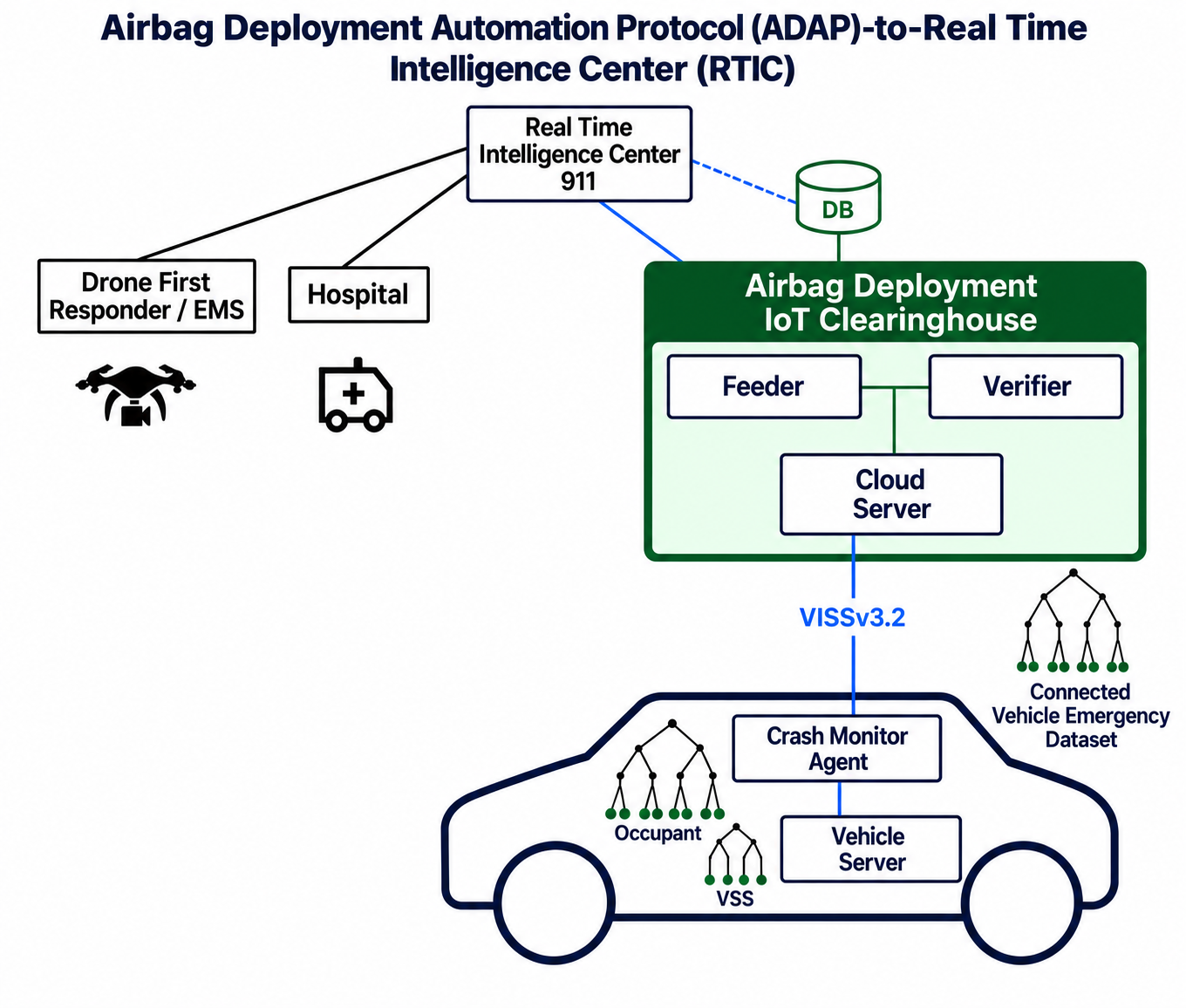
Choose your perspective to explore the integration questions and a practical starting point.
Vehicle Signal Specification provides a common vocabulary for vehicle signals. The supplied architecture uses VISS v3.2 as its vehicle-data interface.
The Connected Vehicle Emergency Dataset is under development within the COVESA initiative to structure vehicle emergency data for machine-to-machine exchange.
Define sender trust, message validation, data minimization, access controls, and CAD handling during scoping and controlled evaluation.
Development initiative: this site presents the proposed architecture and participation pathway. It does not assert a finalized CVED standard, certified interoperability, or nationwide operational availability.
The October 2026 blueprint for connecting a vehicle-generated crash event to RTIC intelligence.
Download diagram ↓The Monitoring Association’s ASAP program demonstrates the alarm industry’s approach to digital notifications and CAD workflows. It is an inspiration for this automotive pathway, not an LSL affiliation.
Explore the ASAP program ↗Explore LSL’s connected-safety mission, coalition activity, and pathway from co-design to operational validation.
Visit the coalition ↗Airbag Deployment Automation Protocol-to-Real Time Intelligence Center is an automotive emergency-data pathway that connects a detected airbag deployment to verified crash intelligence for public safety operations.
No. ASAP serves alarm monitoring and emergency communications centers. ADAP-to-RTIC applies a similar digital-exchange concept to connected vehicles and RTIC workflows. The programs have different domains, payloads, and integration requirements.
Drone dispatch depends on agency policy, operational readiness, aviation requirements, and the deployed integration. The crash event supplies intelligence; each participating agency defines its authorized response.
CVED is under development. Dataset definitions, verification requirements, and implementation profiles must be agreed and validated with participating stakeholders.
Start with an LSL Automotive IoT Scoping Services engagement to map available signals, receiving systems, trust requirements, and a bounded demonstration plan. Services are fee-based; scope and fees are agreed before work begins.
Work with LiDAR Saving Lives to scope your ADAP-to-RTIC use case—from vehicle signals and trusted exchange to CAD workflows and demonstration readiness.
FEE-BASED AUTOMOTIVE IoT SCOPING SERVICES